
Muqi’s Six Persimmons: Learn about Chan (Zen) Buddhism
Speaker: Dr. Cortney Chaffin Kim
A famous monochrome ink painting from China
Muqi, a 13th-century Chinese Buddhist monk, created this famous monochrome ink painting of six persimmons. The monk painter captured the essence of these sweet fruits using very few brushstrokes. Muqi was a Chan Buddhist (or Zen Buddhist) monk, which means he was focused on mindfulness or living in the present. Chan Buddhists believe this can be achieved through meditation, the key to enlightenment.
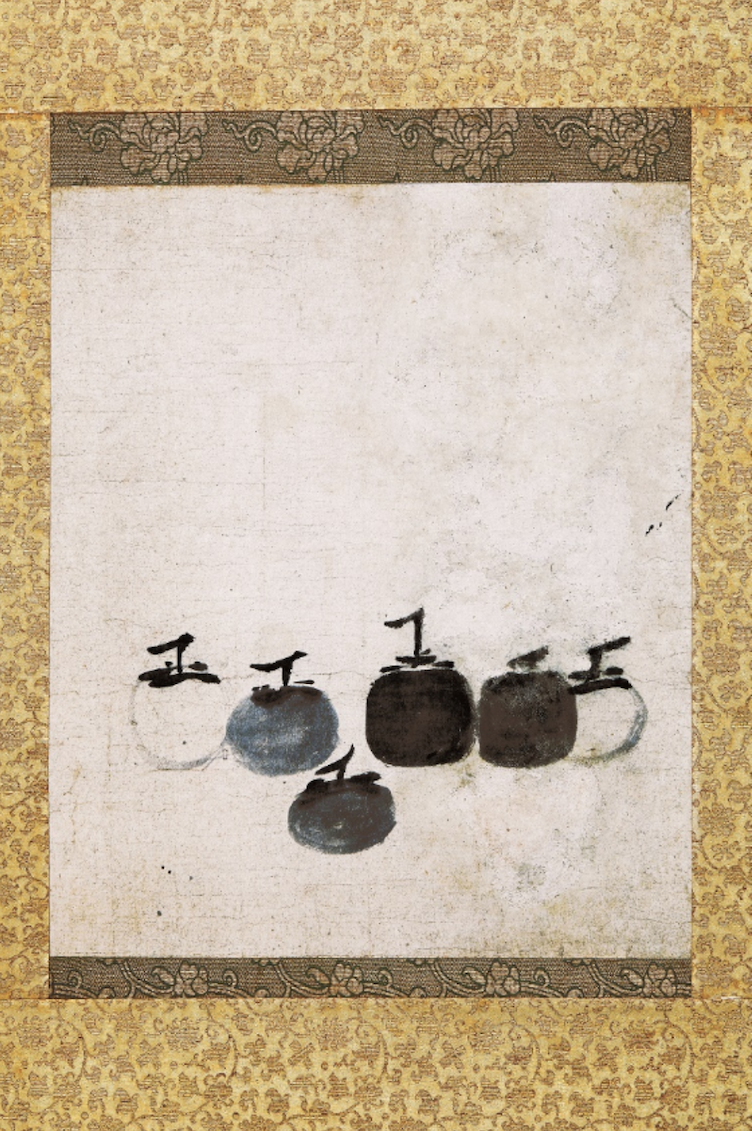
Persimmons, attributed to Muqi Fachang (Chinese, active 13th century), ink on paper, hanging scroll, made originally in China, Collection of Daitoku-ji Ryoko-in Temple
In the United States, this painting achieved a huge boost in fame during the 1960s when Zen Buddhism became popular. Muqi's Six Persimmons became even more famous as a result. Many people called this painting the "Zen Mona Lisa." Muqi's painting had already been popular in Japan and Japanese art for centuries! His painting is kept at the Juko-in sub-temple of Daitoku-ji Ryoko-in Temple in Kyoto, Japan—and it never left this location until 2023 when the painting was on display at the Asian Art Museum of San Francisco for a short time, along with Muqi's other famous ink painting, Chestnuts.
Learn more about why this painting is so famous in the history of art and how you can try your own hand at Chan ink painting at home!
Video chapters
0:06 What's a persimmon?
0:43 Introduction to Muqi's Six Persimmons
1:01 What is Chan or Zen Buddhism?
2:06 What does Muqi's Six Persimmons have to do with Chan and meditation?
2:56 Ink and value tones
3:17 Calligraphic brushstrokes
3:50 The goal of Chan ink painting: capturing the spirit
4:44 Trying to paint like Muqi
-
Hello adventurers! I’m Cortney and I have a question for you. Have you ever tried a persimmon? It’s one of my favorite fruits! It looks kind of like a tomato, but it’s actually a berry and it can be light yellow orange or dark red orange in color. Personally, I like to eat persimmons when they are really, really ripe and almost mushy. When they are ripe, you can cut off the top stem and use a spoon to dig in and eat the deliciously sweet and juicy fruit! Yum!
Why all this talk about my favorite fruit? Well, today we are going to look at a painting called Six Persimmons that was made around 800 years ago in the 13th century during the Southern Song dynasty by Muqi, one of the most famous Chan Buddhist ink painters in Chinese history!
Before we take a close look at Muqi’s painting, you are probably wondering, what is Chan? Chan, also known as Zen, is a branch of the Buddhist religion, one of the largest religions in the world, that focuses on meditation. In fact, both the words Chan and Zen mean meditation! Chan was founded in the 6th century (so, around 1400 years ago) by a monk named Bodhidharma. Bodhidharma traveled from India or Persia to China to share his ideas about Buddhism. He taught that one of the most important ways that a person could reach enlightenment, or release from suffering, was to cultivate one’s mind through meditation. Meditation is sitting quietly not thinking about what you are going to do later or what you did earlier. It’s being completely present in the moment, like when you are eating your favorite fruit and you are savoring every bite, totally focused on the yummy flavor!
What does Chan Buddhism and meditation have to do with Muqi’s Six Persimmons? Let’s take a closer look at the painting. What do you see? There are six persimmons of different shapes and sizes drawn in different shades of black ink against a plain background. The persimmons seem to float in space. There isn’t a background or a “setting” for the persimmons, but we can almost imagine they are laid out on a table–five are lined up in a horizontal row with two on the left side and three on the right and then one small persimmon is placed in front between these two groups. Notice how the two persimmons on the far right overlap slightly, which creates an illusion of space, the illusion that one is in front of the other.
Three persimmons are colored in different shades of gray, one is shaded black, and two are outlined with a light gray ink. Even though Muqi used lighter and darker hues, or value tones, of black ink to create his persimmons, we can almost imagine their gradient of orange-red colors. Muqi used calligraphic brushstrokes to add the details of the stem and leaves on top of each persimmon. A calligraphic brushstroke is one that varies in width. It is more expressive than if Muqi used thin straight lines with no variation. It also reminds us of Chinese calligraphy. Fun fact, during Muqi’s time, artists used the same tool, the traditional Chinese ink brush, for painting and for writing!
This simple painting was probably done quite quickly. This is because the goal in Chan ink painting like Six Persimmons is to paint one’s subject quickly in as few brushstrokes as possible to capture the spirit of the subject rather than a literal depiction. With just over two dozen strokes of his ink brush, Muqi captured the spiritual essence of six persimmons. The act of creating a painting like this one, quickly and with few strokes, was symbolic of enlightenment, which some followers of Chan believed could happen suddenly during meditation or even while painting! I can imagine Muqi was completely present in the moment when he dipped his brush in ink to create the six persimmons. He didn’t overthink it, but used his brush with spontaneity to create a charming work of art that would inspire generations for years to come.
Are there any objects in your household that you could use to create your own Chan ink painting? Perhaps you have a few clementines or a bunch of bananas you could use for inspiration. Whatever you choose for your subject, all you need to do is arrange your objects in an interesting way, grab a sheet of blank paper and some watercolors and then make a quick painting using as few brushstrokes as you can. Remember, don’t overthink it. Try to empty your mind and focus on the moment, and like a Chan monk, you’ll be able to capture the essence of your subject and maybe even reach sudden enlightenment!
Learn more
Learn more about Buddhism, including Chan Buddhism.
Find more resources about Song dynasty China.
Discover more about later imperial China.