
What is Neoclassicism?
Speaker: Dr. Heather Graham
David's Death of Socrates and Looking to Antiquity
Jacques-Louis David’s Death of Socrates (1787) depicts the philosopher calmly choosing death over abandoning his convictions, presenting his moral integrity as more important than life itself. The painting is an example of Neoclassicism, an eighteenth-century movement marked by renewed fascination with ancient Greek and Roman art. In this video, we discuss how Neoclassical artists adopted classical forms, like clear geometry, idealized anatomy, shallow space, and restrained emotion, to evoke reason, order, and virtue.
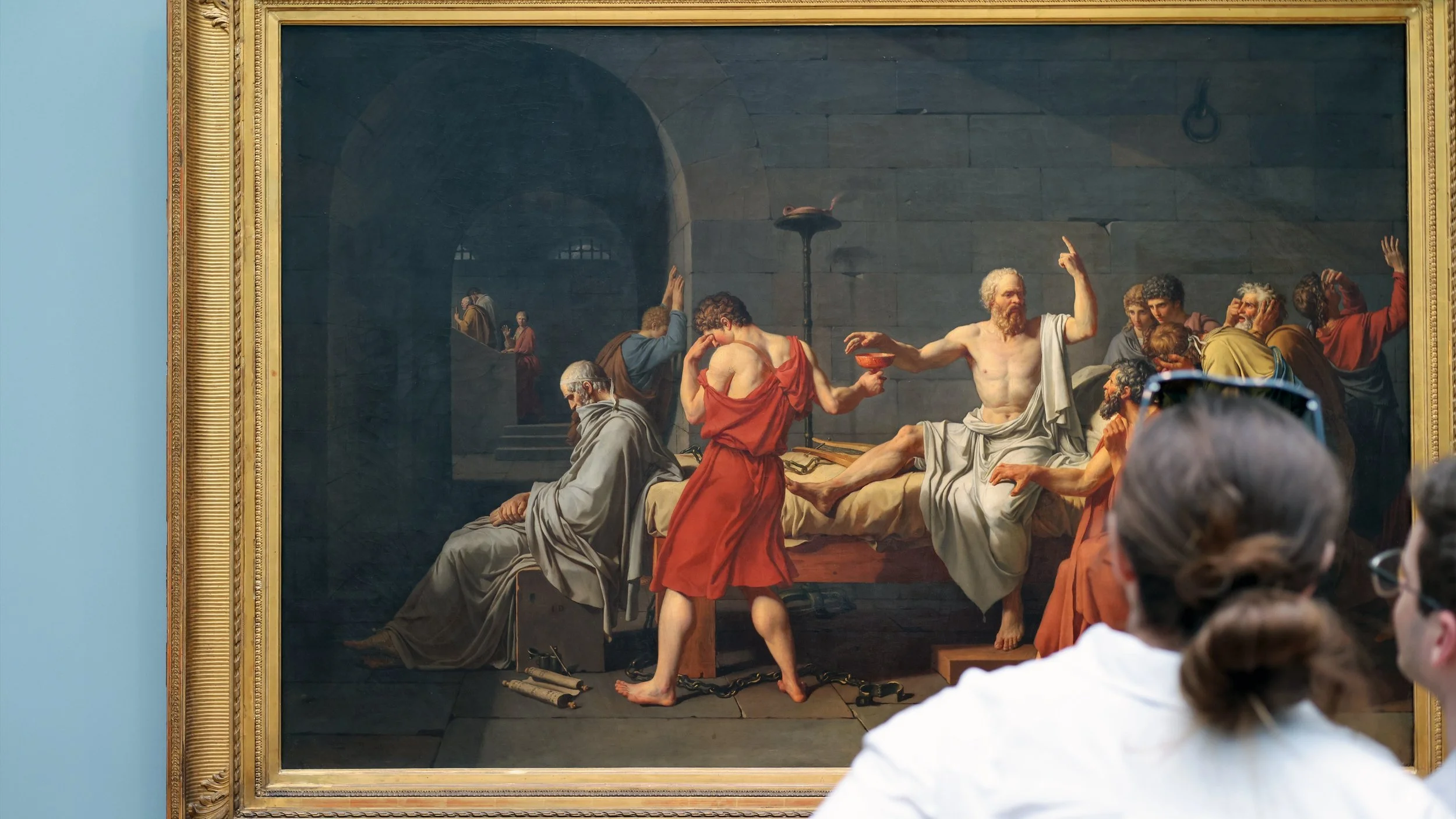
Jacques-Louis David, The Death of Socrates, 1787, oil on canvas, 51 x 77 1/4 in. (129.5 x 196.2 cm). The Metropolitan Museum of Art, NYC. © Dr. Lauren Kilroy-Ewbank
David’s painting not only imitates ancient style but also revives an ancient subject whose story resonated with Enlightenment ideals of reason, civic duty, and self-sacrifice. Painted just before the French Revolution, the work encouraged viewers to think about justice, good leadership, and standing up for one’s values.
CHAPTERS
0:00 A Powerful Choice
0:10 The Painting: An Ancient Story
0:43 What Is Neoclassicism?
1:24 Reviving Ancient Forms
2:18 Inspired by Ancient Re-Discoveries
3:20 Artists and Collectors Draw from the Past
4:30 Reviving Ancient Subjects: Why Socrates Matters
5:00 Enlightenment Ideas
5:21 Modeling Republican Virtue
5:54 A Message for the Time
Learn more
See all our resources about early modern Europe.
Find more AP Art History Unit 4: Later Europe and Americas materials.
Join our newsletter for stories, behind-the-scenes shenanigans, early access to ideas, and more.