
Leon Battista Alberti, Façade for Santa Maria Novella in Florence
Speaker: Dr. Heather Graham
An important Renaissance building
The Dominican Church of Santa Maria Novella is one of the defining monuments of the Italian Renaissance in Florence, Italy. The fifteenth-century marble façade was designed by Leon Battista Alberti and paid for by the merchant Giovanni Rucellai.
In this video, we consider how Alberti combined classical Roman forms with local Florentine architectural traditions, using innovative forms to unify the church’s uneven Gothic structure into a balanced and elegant design. Rich with symbolic references to the Rucellai family, the Dominican Order, and Florence’s civic identity, the façade reflects the close relationship between artistic innovation, religious devotion, and elite patronage.
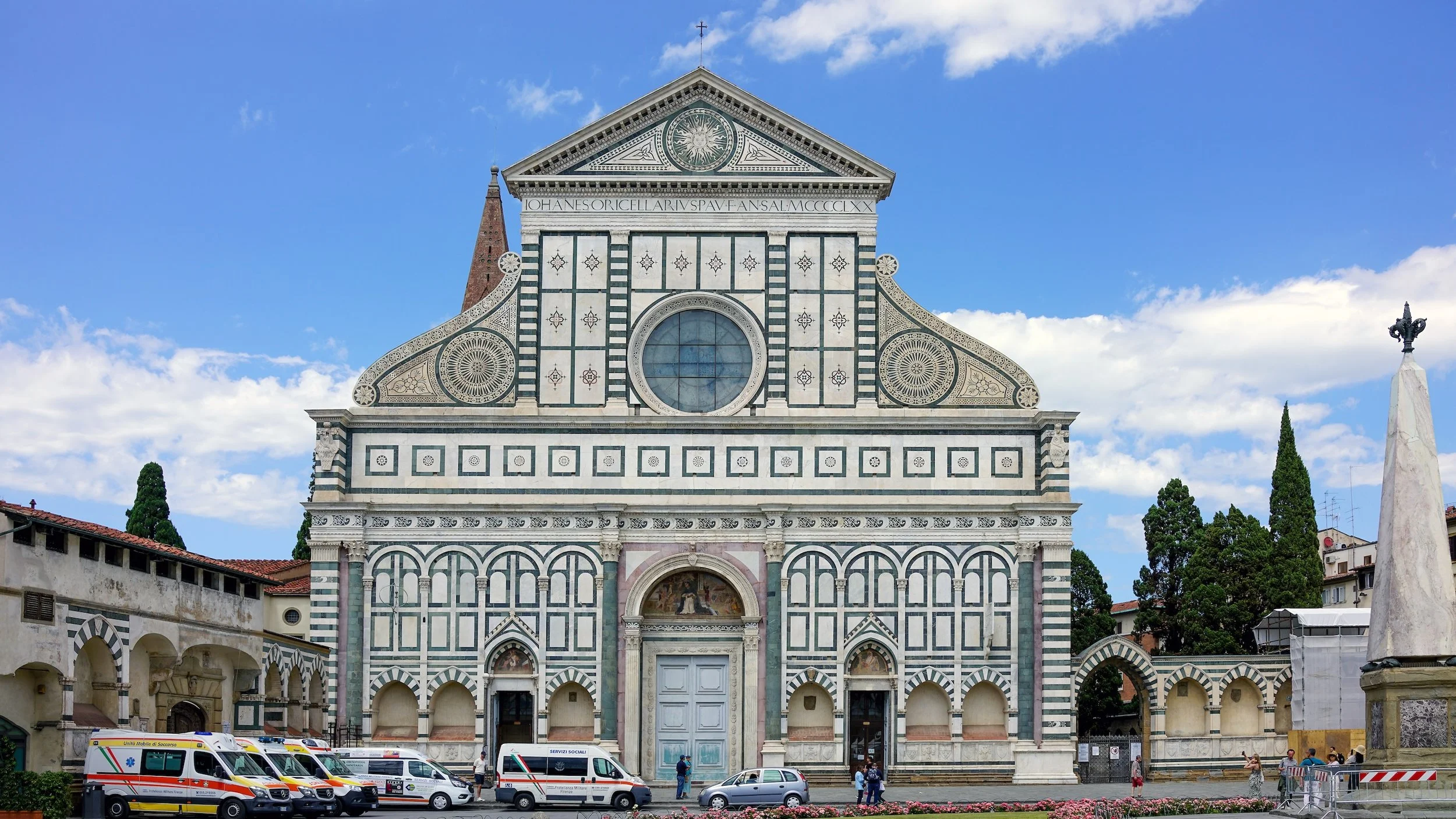
Santa Maria Novella, façade completed by Leon Battista Alberti in 1470, Florence, Italy. Photo: © Lauren Kilroy-Ewbank
Video chapters
00:00 A landmark in Florence
00:50 What is a façade?
01:08 The Dominican Context
01:38 Leon Battista Alberti and Renaissance Humanism
02:04 Solving an architectural challenge
02:41 Geometry and harmony in marble
03:10 Florentine and Classical traditions
03:58 Reading the lower façade
04:10 Symbols of patronage and power
05:07 Reading the upper façade
05:58 A monument for the ages
Learn more
See more resources about Italian renaissance art